
 English
 Español
 Français
 Deutsch

A patio can host a dinner, a backyard can hold an evening gathering, and a garden can offer a quiet corner after work. Each of these uses asks something different from the lighting overhead. Choosing an LED String Light Outdoor arrangement means looking at hanging height, strand path, and the shape of the space together. Hanging lights wherever a hook happens to fit often leaves the dining table dim and the walkway glaring, while a planned layout directs light to where people actually sit and move.
How Height Changes LED String Light Coverage
Installation height sets the distance between the bulbs and the surfaces below. When an LED String Light hangs above a patio, that distance affects how light falls on the table, the seats, and the nearby path.
A lower strand creates a defined, intimate pool of light over a small seating area. Hung too close to head level, it interrupts movement and makes the space feel crowded. A higher strand spreads light across a wider visual area, but the light reaching any single surface becomes less concentrated. Raising the lights does not automatically improve usable coverage.
Picture a patio with a dining table in the middle. Lights directly above the table create a clear focal point, whereas lights moved toward the edges favor the surrounding surfaces. In a large backyard, a high strand may be visible from every corner while the ground beneath it receives uneven light.
Useful points to review before fixing any height:
- The distance between bulbs and the ground.
- The position of furniture under the strand.
- The areas where people walk or gather.
- The direction the bulbs face.
- Nearby walls, trees, and overhead structures.
Choosing a Hanging Height for an LED String Light Outdoor Setup
No single height suits every yard. Clearance, support structure, space size, and the activity underneath all influence the decision.
Headroom comes before appearance. A layout that looks charming in a photograph may be a nuisance when a guest carries a tray beneath it. Check walking routes between house and garden, the height of chairs and tables, spots where people stand to talk or serve food, gates and doors, and any change in ground level. A gentle curve between supports looks inviting, but heavy sagging cuts into clearance.
The support structure also shapes the layout.
| Outdoor Structure | Hanging Approach | Coverage Consideration |
|---|---|---|
| Pergola | Follow overhead beams | Spread light across the seating area |
| Patio | Use suitable wall and post supports | Keep dining and walking zones clear |
| Backyard | Install independent supports | Cover the intended gathering area |
| Garden | Use selected support points | Highlight chosen sections |
| Covered terrace | Follow the overhead frame | Maintain comfortable clearance |
Supports should guide the layout without dictating it. The area that needs light still decides the final position.
Strand Paths: Perimeter, Parallel, and Crisscross
Height describes the vertical position, and the path describes where the strand travels. Two installations at the same height can light a space very differently.
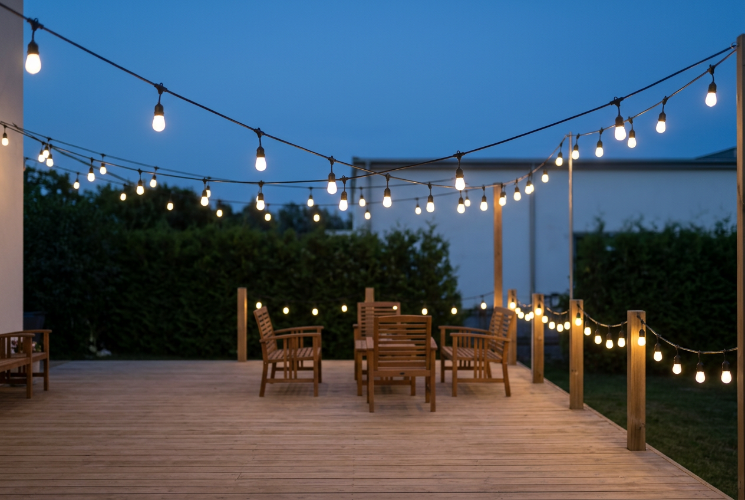
Perimeter layouts follow the edges of a patio or deck. They outline the space and leave the center visually open, which suits areas with clear boundaries and walls or posts for mounting.
Parallel layouts run strands in the same direction across a rectangular patio or dining space. They produce an even overhead rhythm. Line them up with tables and access routes instead of merely following the patio dimensions.
Crisscross layouts use intersecting strands for a decorative canopy in open entertainment areas. Crossing points deserve care, because an intersection above a busy path or an awkward furniture position can feel cluttered.
Planning Coverage for Different Outdoor Areas
Each space has its own shape and habits, so the layout should follow them.
Patios and Dining Areas
Place the main strand over the table or dining zone and keep room for people to stand and move. Avoid hanging bulbs directly in front of regularly used doors. If the patio also has a lounge corner, extend the lights toward it without making every section look identical.
Backyards and Gardens
Backyards often combine lawn, seating, planting beds, and a grill area. One straight strand rarely serves all of them. Identify the zones that need light, then plan the path around them. In gardens, keep strands away from branches that sway or grow into the cord, and leave room for pruning and watering. A White LED Light Strand suits this setting well, since its clean appearance sits comfortably beside greenery, wood, and stone.
Pergolas and Covered Spaces
Beams give natural guide lines. Run strands along them for a structured look, use parallel lines above seating, or gather lights around the dining section to mark a zone. Keep the installation clear of movable shade panels, and avoid adding strands just because extra beams exist.
Walkways
People moving at night should not meet low cords or awkward mounting points. Place strands along boundaries instead of across the main route. Entertainment areas often work best with overhead string lights combined with separate path lighting, so the strands need not illuminate everything.
Matching Length and Spacing to the Space
Hanging height is only part of the plan. Strand length and the gap between lines also shape coverage.
Measure the real route, not just the straight distance between two ends. Corners, curves, and the planned drop all add length. A sound routine looks like this:
- Mark the intended mounting points.
- Measure the distance between each support.
- Add allowance for the curve or drop.
- Check where the power connection sits.
- Compare the total route with the product length.
Spacing between parallel lines affects continuity. Lines set too far apart create disconnected patches, and lines set too close make a small patio feel busy. Consider the width of the space and the furniture arrangement before fixing the supports. The goal is a connected arrangement that relates to the usable area, not a canopy that fills every overhead gap.
Selecting an LED String Light for the Planned Layout
With the route and mounting points settled, product choice becomes easier. An LED String Light should fit the environment, the supports, and the hanging route.
Check these points before buying:
- Whether the length suits the planned route.
- Whether the hanging design works with available supports.
- Whether the specifications state suitability for outdoor use.
- Whether bulb and cord style match the decor.
- Whether the installation instructions support the planned arrangement.
A White LED Light Strand blends with contemporary patios, traditional garden seating, pergolas, and dining areas. Its look changes with the backdrop: pale walls produce a different impression from dark timber, brick, or dense foliage. Placement matters as well, since a strand along a beam reads differently from one suspended across open ground.
Outdoor conditions are demanding, so review the manufacturer's guidance on outdoor suitability, cord and bulb construction, mounting methods, environmental limits, and storage.
Planning Mistakes That Reduce Coverage
Many problems start before the lights are switched on.
- Wrong height: a low strand blocks movement, while a high one may leave seating dim. Test the arrangement standing, sitting, and walking.
- Ignoring the shape of the space: a narrow patio, a wide lawn, and an irregular garden need different routes. Sketch the area and mark the sections that need light.
- One direction for everything: parallel lines do not suit every site. Separate seating zones may call for perimeter or intersecting paths.
- Missed areas: an attractive canopy can still leave an entrance, dining corner, or walkway dark. Review the whole area after installation, not only the bulbs.
- Weak support: do not let the cord carry tension across long unsupported spans. Follow the instructions and use proper supports.
Planning around how people use the space gives an LED String Light Outdoor layout its practical value. Height, strand path, length, and product choice work together, and a short walk through the yard with a tape measure and a sketch usually settles most of the decisions.