
 English
 Español
 Français
 Deutsch

A porch railing glows evenly near the outlet, then fades toward the far corner. A garden strand shows one dim stretch beside a connector, and a few bulbs on a balcony look weaker than their neighbors. A White LED Light Strand is meant to give a clean, steady glow, so these differences are noticeable. Uneven brightness usually traces back to bulb variation, electrical supply, wire resistance, or poor connections.
Identifying the pattern of the problem points toward the cause, protects the equipment, and often avoids replacing a strand that still works.
Why Does Brightness Look Uneven?
The location of the difference is a useful clue. A strand with inconsistent light does not always have damaged bulbs. The issue may come from how electricity travels along the wire or from how individual components behave.
A Few Bulbs Differ
Possible reasons include small differences in LED performance, aging, internal damage, or inconsistent contact around one bulb. Inspect the area before assuming the whole strand needs replacing.
The Far End Is Dimmer
A gradual fade from the plug to the last bulb often suggests a supply issue. Resistance in the wire causes voltage to fall along its length, so bulbs far from the power source may receive less.
One Section Looks Different
A dim stretch often points to a local wiring or connection fault. Check whether it sits near a connector, an extension point, or a spot that has been bent repeatedly.
Can Differences Between LED Bulbs Cause It?
Even when bulbs look alike, internal parts may not perform identically.
Manufacturing Variation
Slight differences in materials and assembly can change light output. A well-made White LED Light Strand uses consistent components so the finished display looks uniform.
Aging
Output can change after long use. Frequent operation, heat around the bulbs, poor ventilation, and moisture all contribute. Older bulbs placed beside recent replacements may look dimmer simply because of their history.
Damage
Impact, moisture, and internal faults can affect a single bulb. Look for cracks, discoloration, loose housings, or moisture. Never open sealed bulbs or handle exposed parts while the strand is connected to power.
How Does Voltage Drop Affect a Strand?
Current meets resistance as it travels through wire, and under some conditions the voltage available farther along falls. Wire material and thickness, total length, connected load, and connection quality all play a part. A long strand with unsuitable wiring may show clear differences between the first and last bulbs.
Bright bulbs near the plug and dim ones at the end suggest voltage drop, though the pattern alone does not prove it. Internal circuit layouts vary by manufacturer. Product specifications should be checked before adding extensions or joining more strands.
Adding sections can look like an easy way to cover a larger area, but connecting more than the power system supports affects performance.
| Installation Condition | Possible Brightness Effect |
|---|---|
| Long wiring distance | Gradual dimming |
| Excessive connected load | Reduced or unstable light |
| Unsuitable wire specifications | Uneven power delivery |
| Poor connection between sections | Local brightness changes |
Recommended strand length and connection limits should always follow the manufacturer's instructions.
Can the Power Supply Be the Cause?
A strand relies on a compatible power source. Bulbs and wires may be fine while an unsuitable adapter changes how the lights behave.
Undersized Adapter
If output cannot meet the strand's needs, lights may look dim or behave inconsistently. This happens when an adapter has too little capacity, when extra strands exceed the supported load, when several products share one source, or when the original adapter is replaced with an incompatible one. Match rated voltage and current from the product label.
Wrong Voltage
An unsuitable output can cause abnormal brightness, flickering, or damage inside the components. Higher voltage does not mean a brighter or safer result, and lower voltage may stop the strand from working properly. Adapters from unrelated products should not be tried as an experiment.
Aging Adapter
Heat, long use, or physical damage can make power unstable. Warning signs include brightness changing during operation, inconsistency after the adapter warms up, a loose connection, or a damaged housing. Disconnect the product if the adapter becomes very hot, smells burnt, or shows damage, and replace it with a compatible one.
Do Loose Connections and Wiring Faults Matter?
Not every problem comes from bulbs or adapters. A strand can work well in one area and dim in another because of a damaged wire, loose connector, or worn contact.
Loose Connectors
Symptoms include a section that dims on and off, flicker when the joint is touched, different brightness on either side of a connector, or a strand that stops after installation or movement. Disconnect the product before checking accessible connections, and never adjust exposed wiring while it is live.
Damaged Wire
Railings, trees, windows, and fences put strands under bending and pressure. Check sharp corners and tight fasteners. If insulation is cracked or a conductor is exposed, stop using the strand, and do not cover an electrical fault with ordinary tape.
Moisture Outdoors
Rain and condensation entering an unsuitable connection cause corrosion. For outdoor use, confirm that the strand is rated for it, connectors have moisture protection, power connections sit away from standing water, and cables are protected from damage. An indoor strand should not be moved outside without checking its intended environment.
How Can the Problem Be Troubleshot Step by Step?
A structured check often avoids replacing the whole strand.
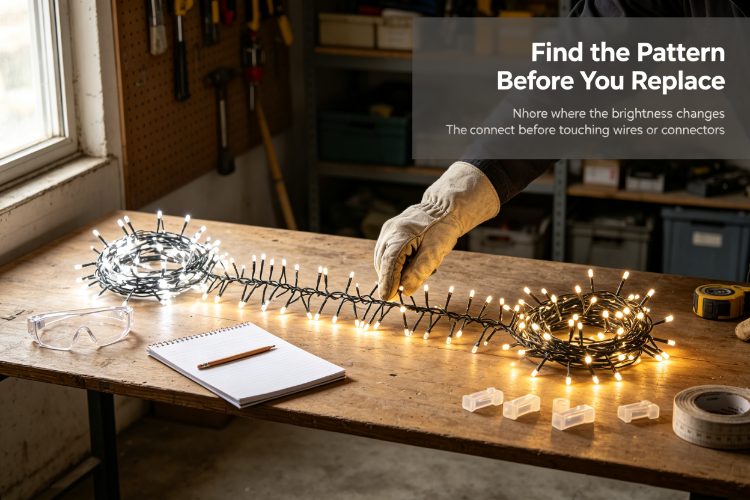
- Identify where brightness changes. Watch the strand in normal operation and note whether individual bulbs, a gradual fade, a whole section, or intermittent change appears.
- Check the power supply. Disconnect first, compare the label with the adapter, and look for damaged plugs, overheating, or loose fit. A matching plug does not mean a matching adapter.
- Inspect wiring and connectors. Follow the visible wire, paying attention to bends, extension points, plugs, and areas exposed to movement or weather. Do not pull or bend a damaged section to test it.
- Examine the bulbs. Look for discoloration, cracks, moisture, or odd output. Replaceable bulbs should be swapped following the manufacturer's instructions. Sealed housings should not be taken apart.
- Decide on repair or replacement.
| Observed Problem | Suggested Action |
|---|---|
| A few bulbs look dim | Check bulb condition and nearby connections |
| Far end looks darker | Check strand length and electrical specifications |
| Whole section is dim | Inspect accessible connectors and wiring |
| Entire strand looks weak | Check adapter compatibility |
| Lights flicker | Disconnect and inspect for electrical damage |
If the cause is not clear after an external inspection, contact the manufacturer or a qualified electrical professional.
How Can Uneven Brightness Be Prevented?
Patios, balconies, gardens, and entrances increasingly rely on string lighting, so selection and care matter.
Bulb Consistency
Compare brightness between bulbs, stability in normal use, housing durability, and a uniform white tone across the strand. Large displays show differences more clearly.
Power Match
Check voltage, current, power requirements, and supported connections. Avoid adapters of unknown specification and avoid joining extra sections without confirming compatibility.
Wire and Installation
Look at wire construction, supported length, connection design, indoor or outdoor suitability, and moisture protection.
Careful Handling
- Check the strand and adapter before installation.
- Avoid stretching wire tightly between fixing points.
- Keep connectors protected from moisture where required.
- Use suitable clips instead of nails or staples.
- Disconnect before cleaning or storing.
- Coil loosely and keep heavy objects off the strand.
How Can Buyers Choose a Suitable Strand?
Appearance and electrical compatibility both count. Whether the plan is a living room, a balcony outline, or a garden gathering space, consistent light makes the result feel cohesive. Bulb design, wiring construction, power compatibility, and installation environment are the details worth comparing before buying a White LED Light Strand. Readers planning a project are welcome to contact our team with their application to discuss specifications and a lighting arrangement that suits their installation.