
 English
 Español
 Français
 Deutsch
Rubber cable LED Christmas lights are decorative lighting products designed for seasonal use, particularly during the Christmas period. The defining feature of this category is the use of rubber-insulated cables, typically made from materials such as PVC or synthetic rubber, which provide flexibility and environmental resistance. These lights are manufactured in several structural types to meet different installation needs.
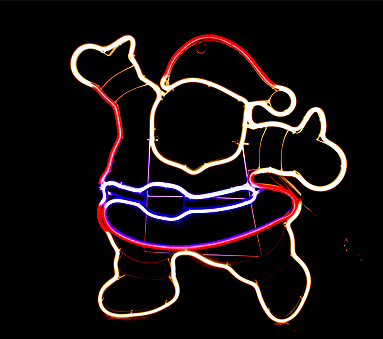
One common type is the LED string light. This design consists of evenly spaced LED bulbs mounted along a continuous rubber cable. String lights are used for wrapping trees, railings, fences, and building facades. They are available in fixed color, multicolor, and programmable versions. Another type is icicle lights, where short vertical drops extend from a horizontal main cable, creating a hanging effect often installed along rooflines. Net lights form a grid pattern and are suitable for covering bushes or hedges with uniform spacing. Rope lights enclose multiple LEDs inside a transparent rubber tube, forming a continuous linear lighting strip that can outline architectural shapes.
In addition to shape-based categories, these lights can also be classified by voltage and control mode. Low-voltage systems, often operating at 12V or 24V through a transformer, are commonly used in residential settings. High-voltage versions, such as 110V or 220V direct plug-in models, are often used for larger outdoor installations. Some models include simple steady-on operation, while others incorporate flash controllers or programmable sequences for dynamic effects.
Why Are Rubber Cable LED Christmas Lights Worth Buying?
Weather Resistance
Rubber-insulated cables provide protection against moisture, dust, and temperature variation. Outdoor-rated products often meet IP44, IP65, or higher ingress protection standards. This allows the lights to function during rain or light snow when properly installed. Compared with thinner plastic wires, rubber cables are generally thicker and more resistant to cracking in cold conditions.
Mechanical Durability
Rubber cables offer flexibility and tensile strength. During installation, lights are often bent, wrapped, or temporarily tensioned. A rubber outer jacket helps reduce the risk of internal wire breakage. This characteristic is relevant for repeated seasonal installation and removal.
Electrical Safety
Many rubber cable LED Christmas lights include molded plugs and sealed connectors. Low-voltage systems use transformers to step down household voltage, reducing shock risk. In addition, LED technology generates less heat than traditional incandescent bulbs, lowering the likelihood of overheating during extended operation.
Energy Efficiency
LED light sources consume less electrical power per lumen compared to incandescent alternatives. This reduces overall energy consumption for long operating hours, which is common during holiday displays. Lower power consumption also allows longer connection chains within rated load limits.
Versatile Applications
Rubber cable LED lights can be used in residential, commercial, and municipal projects. They are suitable for tree decoration, architectural outlining, event venues, and temporary exhibitions. Their compatibility with extension connectors allows scalable layouts.
How Are Rubber Cable LED Christmas Lights Designed?
The design of rubber cable LED Christmas lights begins with electrical circuit planning. LEDs are arranged in series or series-parallel circuits depending on operating voltage. For low-voltage systems, a transformer converts household AC voltage into a lower AC or DC output. In higher-voltage systems, rectifier circuits may be integrated into the plug assembly.
Each LED is mounted onto insulated copper conductors embedded within the rubber cable. The conductor gauge is selected based on current load and total string length. Proper conductor sizing reduces voltage drop and maintains consistent brightness across the string.
The rubber outer jacket functions as mechanical and environmental protection. Materials such as PVC or synthetic rubber compounds are selected for flexibility, flame retardancy, and UV resistance. For outdoor-rated products, additional sealing processes are applied at LED entry points and connectors to prevent water ingress.
Connectors are typically injection-molded to ensure tight sealing between male and female ends. Waterproof gaskets or threaded locking rings may be included for improved reliability. Some designs allow end-to-end connection of multiple light strings, with specified connection limits to prevent overloading.
Heat management is addressed through low-power LED selection and appropriate resistor or driver design. Because LEDs operate efficiently, heat generation is limited, but circuit design must still account for continuous operation over several hours.
From a structural perspective, spacing between LEDs is standardized according to lighting density requirements. Common intervals include 5 cm, 10 cm, or customized spacing depending on decorative effect. For rope lights, LEDs are inserted into a transparent flexible tube, which diffuses light and protects internal wiring.
Rubber cable LED Christmas lights are available in string, icicle, net, and rope formats, with variations in voltage and control systems. Their value lies in environmental resistance, durability, electrical safety, and energy efficiency. The design integrates electrical engineering principles, material selection, waterproof construction, and mechanical flexibility to ensure stable operation during seasonal decorative use.